How to Build an Annual Training Calendar for Law Enforcement Agencies
Published April 2026 · ConfiTrek Research Series · Estimated read time: 8 min
The annual training calendar is one of the most consequential planning documents a law enforcement training coordinator produces — and one of the most commonly underbuilt. In too many agencies, the “annual training plan” is a loosely assembled list of courses that get scheduled when opportunities arise, with compliance tracking happening reactively rather than proactively. Officers miss deadlines because training was not scheduled with enough lead time. Budget overruns happen because training costs were not estimated at the start of the fiscal year. Reimbursement is left unclaimed because expense tracking was not built into the planning process from the beginning.
A well-constructed annual training calendar is not just a scheduling tool. It is a compliance management framework, a budget planning instrument, and a risk mitigation document — built once at the start of each year, maintained throughout, and serving as the operational backbone of your department’s entire training program. This guide walks through the process of building one from the ground up.
Step 1: Start With Your Compliance Obligations, Not Your Training Preferences
The foundational mistake in annual training planning is beginning with the courses your department wants to offer rather than the obligations it must meet. A training calendar built without a complete compliance inventory at its core will always have gaps — sometimes discovered only when an officer’s licensing deadline has already passed.
Before scheduling a single training event, compile a complete compliance inventory for your department:
- Every officer on your active roster, with their current licensing cycle start and end dates
- The specific CE requirements applicable to each officer based on their state, license type, and current cycle status
- Mandatory topic requirements — use of force, de-escalation, crisis intervention, bias training, and any other mandated categories in your jurisdiction
- Per-year minimums where your state requires them (as Minnesota does with its 16-hours-per-year rule)
- Civilian employee certification obligations — dispatcher CE, CJIS renewals, EMD renewals, CPR, and any role-specific requirements
- Specialty credential renewals — firearms qualifications, TASER certifications, K9 handler requirements, and any custom credentials your agency maintains
- Policy acknowledgement obligations, particularly for policies scheduled for review and update in the coming year
This compliance inventory is the master list from which every training event on your calendar must be sourced. Any event that does not connect to a compliance obligation is discretionary. Any compliance obligation that does not connect to a scheduled event is a gap that needs to be closed.
Step 2: Map Compliance Obligations to a Twelve-Month Timeline
With your compliance inventory complete, the next step is mapping each obligation to a specific window in the calendar year. This is where most manually built training plans begin to struggle — the complexity of managing individual officer timelines across a full roster quickly exceeds what a spreadsheet or calendar application can handle reliably. But the principles behind the mapping are straightforward:
- Work backward from deadlines, not forward from availability. The question is not “when can we schedule use of force training?” but “when does use of force training need to be completed for each officer, and what scheduling window does that create?”
- Distribute training across the year deliberately. In states with annual minimums, officers cannot complete all their required hours in Q4. Even in states without annual minimums, front-loading training creates budget and scheduling pressure while back-loading creates deadline risk. Aim for even quarterly distribution unless officer cycle timing makes another pattern more appropriate.
- Group officers with similar cycle timelines into training cohorts. Officers whose licensing cycles end in the same quarter benefit from training events scheduled together — simplifying logistics, reducing per-officer costs, and enabling group training formats where applicable.
- Build makeup windows into the plan from day one. Officers on leave, light duty, injury, or FMLA will miss scheduled training. Every mandatory training event needs a makeup date or alternative enrollment option built into the calendar — not added as an afterthought when the original date has passed.
A Framework for the Twelve-Month Training Calendar
| Quarter | Planning Focus | Typical Training Events | Administrative Tasks |
|---|---|---|---|
| Q1 (Jan–Mar) | Foundation and early mandatories | Annual firearms qualification (round 1), de-escalation, use of force refresher, CJIS renewals due in current year | Compliance inventory finalized; training calendar distributed; budget submitted; reimbursement form filed for prior year |
| Q2 (Apr–Jun) | Specialty and topic-specific mandates | Crisis intervention, implicit bias, mental health response, EMD renewals, CPR/first aid renewal cycle | Mid-year compliance check: officers behind on Q1 requirements identified; makeup sessions scheduled; Q2 expense documentation captured |
| Q3 (Jul–Sep) | Elective and custom credentials; mid-cycle review | Specialty unit training (SWAT, K9, TASER), dispatch CE, community policing, defensive tactics | Third-quarter compliance status review; officers approaching year-end deadline identified; conference and external training requests processed |
| Q4 (Oct–Dec) | Completion and closeout | Annual firearms qualification (round 2 or makeup), makeup sessions for missed mandatory training, policy acknowledgement cycle completion | Year-end compliance reconciliation; licensing cycle closeout for officers whose period ends December 31; expense records compiled for reimbursement filing |
Step 3: Build the Budget Alongside the Calendar
A training calendar without a budget is a wish list. Every training event on your calendar carries a cost — registration fees, instructor fees, facility costs, travel, and the salary cost of officers attending training. The annual training calendar provides the framework for building an accurate training budget: you know which events you need, roughly when they will occur, and how many officers will attend each.
A training budget built from a compliance-first calendar has several advantages over a budget built from historical spending:
- It accounts for every mandatory training event, not just the ones that were scheduled in prior years
- It can be built to reflect the actual cost of compliance — which is the argument training coordinators need when requesting budget approval from command staff or city administrators
- It provides the basis for POST reimbursement claims, since reimbursable expenses are a subset of the total training budget and can be tagged from the beginning
- It creates accountability for training spending throughout the year, rather than discovering budget overruns in Q4
Step 4: Build In the Communication Plan
The best-designed training calendar fails if officers and supervisors do not know what is scheduled, when it applies to them, and what happens if they miss a required event. Effective training calendar communication includes:
- Annual calendar distributed to all officers and supervisors at the start of the year, with each officer’s specific required events highlighted
- Reminder notifications issued at 60 and 30 days before each mandatory training event to officers who have not yet completed the requirement
- Supervisor notifications when officers under their command are approaching a mandatory deadline without a scheduled training event on their record
- A clear process for officers to request alternate enrollment in a training event they cannot attend as scheduled — submitted through a defined workflow, not via informal conversation
- Regular compliance status updates shared with command staff — not just the training coordinator — so organizational compliance health is a visible leadership metric
Step 5: Maintain the Calendar as a Living Document
A training calendar built in January is not a document you set aside until December. Compliance is dynamic — new requirements emerge mid-year, training events are rescheduled, officers transfer in and out, and the POST board updates its standards. An effective annual training calendar is reviewed and updated at least monthly, with a formal quarterly review that assesses compliance status across the full roster and adjusts the remaining schedule accordingly.
The quarterly compliance review should answer these questions explicitly:
- Which officers are behind on their mandatory training requirements and by how much?
- Are there officers whose licensing cycle ends this year who are at risk of not completing their requirements?
- Have any new POST requirements been announced that need to be incorporated into the calendar?
- Are training events being documented in the compliance tracking system in real-time, or is there a documentation backlog?
- Are expense records current and complete enough to support the next reimbursement filing?
ConfiTrek: The Infrastructure Behind a Calendar That Actually Works
A training calendar is only as good as the compliance system behind it. ConfiTrek provides the infrastructure that transforms an annual training plan from a static document into a live compliance management tool — continuously updated, automatically alerting, and always audit-ready.
- Compliance inventory built in: ConfiTrek’s per-officer profiles populate your compliance obligations automatically from state POST requirements, custom credentials, and policy acknowledgement assignments — giving you the complete training obligation picture before you schedule anything
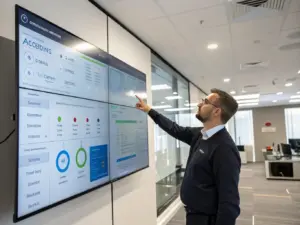
- Real-time compliance dashboards: At any point in the year, the organizational and individual compliance dashboards show exactly where each officer stands against their requirements — so quarterly reviews are a matter of reading the dashboard, not assembling data
- Automated notifications: ConfiTrek sends training reminders directly to officers and coordinators as deadlines approach — the calendar communicates itself, without coordinator follow-up
- Training request workflow: Officers request course additions or alternate enrollment directly in ConfiTrek, eliminating paper forms and email chains while creating a documented request record
- Expense tracking integrated: Training costs logged alongside each event throughout the year — budget actuals and reimbursement documentation build automatically as the calendar executes
- Year-round audit readiness: Every training event, every completion, every expense is documented in real time — so the end-of-year reconciliation is a verification, not an assembly project
The difference between a training calendar that works and one that creates compliance emergencies in December is the system behind it. ConfiTrek gives coordinators, command staff, and officers the tools to stay ahead of requirements — not scramble to catch up. Reach us at (612) 979-5180 or sales@confitrek.com to build a compliance infrastructure that matches the ambition of your training program.
Build a Better Training Program with ConfiTrek →