Officer Accountability and Self-Managed Training: Empowering Your Workforce
Published April 2026 · ConfiTrek Research Series · Estimated read time: 7 min
In most law enforcement agencies, training compliance is managed almost entirely by one or two people — the training coordinator and perhaps an assistant or administrative officer. These individuals are responsible for tracking every officer’s CE requirements, monitoring deadlines, entering completion records, chasing officers who have fallen behind, and generating reports that command staff uses to assess departmental compliance health. It is an enormous administrative load, and it places a single point of failure at the center of an organization’s entire compliance infrastructure.
There is a better model — and it is not more complicated or more expensive. It is built on a principle that most professionals in other fields take for granted: people are more engaged with, and more accountable to, standards they can see for themselves. When officers have direct visibility into their own training compliance status — what they owe, what they have completed, what is coming due — the dynamic changes. Training becomes a personal professional standard, not just an administrative obligation that someone else tracks on their behalf.
This report examines the evidence for officer self-accountability in training compliance, what it requires organizationally to make it work, and what the downstream effects are for the department, the coordinator, and the officers themselves.
The Problem With Centralized-Only Compliance Management
The traditional model of compliance management — where a single coordinator tracks requirements and pushes reminders to officers — has several structural weaknesses that become more pronounced as departments grow and compliance requirements become more complex:
- Scalability limits: A coordinator managing compliance for 30 officers is stretched. Managing compliance for 100 officers using the same manual system is unsustainable. The per-officer administrative burden does not decrease as the roster grows; it compounds.
- Single point of failure: When the training coordinator leaves, takes leave, or is overwhelmed by competing priorities, compliance tracking degrades. The institutional knowledge embedded in the coordinator’s manual system does not transfer automatically to a replacement.
- Passive officer posture: Officers who never see their own compliance record have no reason to engage proactively with their training obligations. They rely entirely on the coordinator to tell them what they need and when. This passivity creates a culture where missed deadlines are treated as the coordinator’s fault rather than the officer’s responsibility.
- Delayed error detection: In centralized systems, errors in officer records — missing completions, incorrectly categorized training, wrong cycle dates — are often discovered only during an audit or a licensing renewal, by which point correction may require emergency remediation.
What Officer Self-Accountability Actually Looks Like
Officer self-accountability in training compliance does not mean transferring the coordinator’s responsibilities to individual officers. It means giving officers the tools to participate meaningfully in their own compliance management — while the coordinator retains oversight, reporting, and quality control functions. In practice, it looks like this:
Personal Compliance Dashboards
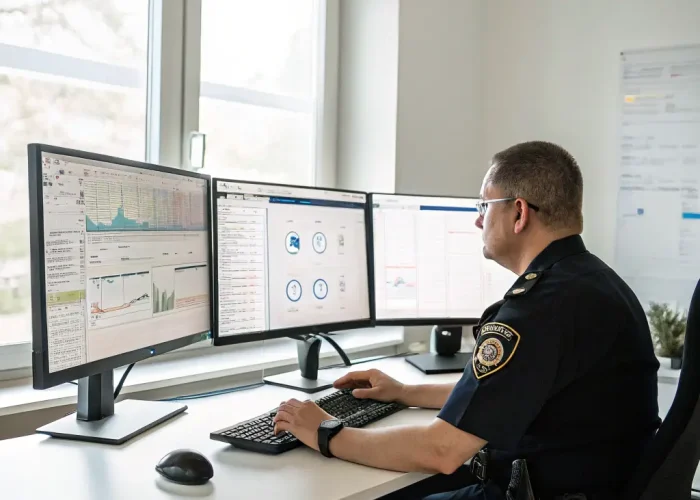
Each officer has access to a compliance dashboard that shows their current CE status — hours completed against their licensing cycle requirement, mandatory topics completed and outstanding, upcoming deadlines, and their current overall compliance percentage. This information is visible to the officer at any time, without having to ask the coordinator. Officers who can see that they are at 60% compliance with four months left in their cycle respond differently than officers who have no visibility into their status until a coordinator reminds them.
Self-Upload of Training Documentation
Officers who complete training through external providers — conferences, approved online courses, regional training programs — should be able to upload their own completion certificates and documentation directly into the compliance system. This eliminates a common administrative bottleneck: the coordinator waiting on officers to submit paperwork before records can be updated. It also gives officers direct investment in the accuracy of their own records, since they can see in real time that their completion has been recorded correctly.
Training Request Workflows
Officers should be able to request approval for specific training opportunities — external courses, conferences, specialized instruction — through a digital workflow that routes the request to the appropriate supervisor or administrator for approval. This replaces the informal conversations and email chains that characterize most training request processes and creates a documented record of both the request and the disposition.
Personal Notification Management
Officers receive automated notifications about their own upcoming deadlines — not as a substitute for coordinator oversight but as a first line of awareness that reduces the number of officers who reach the coordinator’s desk in an emergency because they did not realize a deadline was approaching. An officer who receives a 60-day reminder has six weeks to schedule training. An officer who hears about a deadline from the coordinator at the 10-day mark has a scheduling crisis.
The Accountability Culture Shift
The cultural impact of officer self-visibility into compliance is documented consistently in agencies that have implemented it. The pattern is straightforward: when officers can see their own records, they engage with them. They check their status. They notice errors and report them. They ask the coordinator questions about upcoming requirements before those requirements become emergencies. They become participants in compliance management rather than passive subjects of it.
This shift has a measurable effect on the coordinator’s workload. In departments where officers have self-service compliance visibility, coordinators consistently report spending less time on reactive follow-up — chasing officers who are behind, answering questions that could have been answered by the officer checking their own record, and manually entering data that officers could upload themselves — and more time on proactive management, reporting, and training program development.
| Task | Centralized-Only Model | Officer Self-Accountability Model |
|---|---|---|
| Compliance status communication | Coordinator generates and distributes individual status reports on request or schedule | Officers view their own status in real time; coordinator reviews aggregate dashboard |
| Training certificate submission | Officers submit paperwork to coordinator; coordinator enters records | Officers upload certificates directly; coordinator reviews and approves |
| Deadline awareness | Coordinator monitors all deadlines and sends individual reminders | Officers receive automated personal reminders; coordinator monitors exceptions only |
| Training requests | Informal conversations, emails, or paper forms routed through coordinator | Officers submit requests through digital workflow; approval chain is documented |
| Record error detection | Errors discovered during audit or coordinator review — often months after occurrence | Officers spot their own record errors in real time; correction is immediate |
Accountability Without Blame: Setting the Right Framing
Introducing officer self-visibility into compliance management requires thoughtful framing to avoid creating a surveillance culture that undermines morale. The message that resonates — and the one that is genuinely true — is that self-visibility is a professional benefit, not a monitoring tool. Officers who know their own compliance status are in control of their professional licensure. They are not dependent on the coordinator to tell them whether their career credentials are current. They have the information they need to manage their own professional development proactively.
This framing is particularly effective with officers who have transferred from agencies that did not track compliance rigorously — and who may have had licensing gaps they were unaware of — or with newer officers who are entering their first compliance cycle. Professional ownership of training records is a message that resonates with officers who take their credentials seriously.
Command Staff Accountability: The Top-Down Dimension
Officer self-accountability works best when it is embedded in a culture of accountability that runs from officer to sergeant to lieutenant to command. When supervisors have visibility into the compliance status of the officers under their command — and when that visibility is part of their routine management toolkit, not a special audit event — the social accountability pressure on individual officers increases organically. An officer who knows their sergeant can see their compliance dashboard at any moment approaches their training obligations differently than one who operates in a visibility vacuum.
- Supervisors with team-level compliance dashboards can identify struggling officers early and intervene before deadlines pass
- Roll call and briefing discussions about training schedules become informed conversations rather than general reminders
- Performance reviews can incorporate compliance history as a documented metric rather than a subjective impression
- Chiefs and administrators can report departmental compliance health to city government or oversight bodies with confidence, because they are seeing the same data in real time
ConfiTrek: Compliance Visibility for Every Level of Your Organization
ConfiTrek is built around the principle that compliance is everyone’s responsibility — and everyone needs the right information to fulfill it. The platform gives officers, supervisors, coordinators, and command staff the visibility into training status that each level of the organization needs, in real time, without manual report generation.
- Officer self-service dashboard: Every officer in ConfiTrek has a personal compliance dashboard showing their CE status, mandatory topic completions, upcoming deadlines, and training history — visible at any time from any device
- Officer-initiated certificate uploads: Officers upload their own training completion certificates directly into their profile; coordinators review and approve without re-entering data
- Training request workflow: Digital request submission with documented approval chain — replaces email and paper with a trackable, accountable process
- Automated personal notifications: Officers receive direct alerts as their training deadlines approach — reducing coordinator follow-up burden and giving officers agency over their own compliance timeline
- Supervisor and command staff dashboards: Aggregated compliance views by unit, rank, or department — supervisors see their team’s status; command staff sees the organizational picture
- Organizational compliance reporting: Export-ready reports for city council presentations, oversight board reviews, or accreditation submissions — always current, always ready
Eric Olsen, Chief at Winnebago PD, said it simply: after beginning to use ConfiTrek, the POST Reimbursement Auto-Complete feature made things “10X easier.” That kind of operational relief happens throughout the platform when officers and coordinators alike have the information they need to manage compliance proactively. Call us at (612) 979-5180 or email sales@confitrek.com to see how officer self-accountability works in ConfiTrek.
Explore Officer Self-Service in ConfiTrek →